
Written By John VanDerLaan
We may earn revenue from the products available on this site and participate in affiliate programs. Learn more
One of the most important things that we can do as deer hunters is to help get beginners involved in our sport in order to pass down the traditions of hunting.
Welcome to the ultimate guide to deer hunting for beginners!
Below you will find our best tips for new deer hunters that will shorten the learning curve and help them start hunting and be successful in getting their first deer.
1. Know Your Quarry

The first thing that you should be doing as a new deer hunter is to learn as much as you can about the deer.
Once you learn about the deer, it becomes much easier to predict where he will be and what he will be doing during the season and even at different times during the day
There are many types of deer and it would be impossible to cover hunting tips on all of them in one article, so we are going to focus on hunting whitetail deer and not mule deer for this article, as the North American whitetail is the most sought after game animal in the world.
Preferred Habitat
Deer are incredibly adaptable animals and can live in almost any habitat from dense forest to small city woodlots and everything in between.
The one thing that is a constant in preferred deer habitat is that they love edges.
Edges can be very obvious, such as where a field meets forest, but they can also be less obvious, such as where a steep hillside meets a bench, or flat spot.
Any change in terrain or flora can be an edge and that is where you are going to find deer and other big game.
When are they most active

Deer are crepuscular, which means most deer movement is at dawn and dusk. This can change based on weather and other factors like, time of year, which we will cover later in this article.
Many new deer hunters think that deer are nocturnal. This is generally not true, but some mature deer will become nocturnal during the hunting season as a result of pressure from other hunters being in the woods.
Even the mature deer that become nocturnal will resume normal behavior as the hunting pressure subsides.
Where do they sleep

The next step is to learn where deer sleep.
Deer do not sleep for any significant amount of time. They doze off for short periods of time, but they do bed down during the day and at night. They bed down in what we call bedding areas and they tend to use the same areas quite frequently because they learn which areas are the safest.
These bedding areas will usually have a good field of view where the deer can see predators coming from a long way off and adequate security cover nearby.
The bedding areas will usually have prevailing winds that allow the deer to watch in one direction and use their incredible olfactory senses to smell danger from the opposite direction.
Once you have found the bedding area of the deer, you have the first part of the puzzle.
The next part of the puzzle is figuring out where the deer eat.
Where do they eat

Deer eat a variety of food from crops like corn and soybeans to mast crops like acorns and also browse.
Browse is considered leaves, twigs and succulent buds on woody plants. It gets its name from the fact that the deer and other big game animals are usually moving slowly and taking a bite every few steps.
Deer will have a favorite food in your area during the time that you will be hunting.
In many areas that is going to be acorns. Specifically, white oak acorns. They like all acorns, but the white oaks are like candy to them when they are falling and as a hunter you should take advantage of that.
Apples are another favorite food of the deer. If you are fortunate enough to have apple trees in the area you hunt, you are very lucky.
Some experienced hunters even put in food plots for the deer so that they know where they are going to feed.
Find where the deer are feeding in the area you hunt and you have the second piece to the deer hunting puzzle.
How do they get from where they eat to where they sleep
Deer tend to use the same trails from where they bed down to where they eat. This makes those trails very discernible and easy to find, just look for all the deer tracks.
These trails are where you are going to be hunting whitetail deer. You can catch the deer going from their bedding area to the food plots or other food source in the afternoon and going from the food source to the bedding area in the morning.
The trick is to pattern the deer movement so that you know when they are using these trails.
Then you will know when and where you are going to be waiting when the deer come.
2. Choose Your Weapon

Now that you have some knowledge about deer, their habits and how you are going to plan your hunt. It is time to choose a weapon that you will use.
There are basically two deer hunting seasons. One is bowhunting season and one is firearms season.
Each season is defined by the weapon used.
Let’s take a look at the different weapons.
Bow Hunting

Bowhunting season for deer is usually the longest season and can last from September to February in some states. For this reason, hunting with archery gear has become very popular.
Getting a deer within bow range can be very challenging for a new deer hunter.
Hunting deer with a bow requires stealth and silence. Care should be taken to insure that your gear and clothing are as quiet as possible.
Bow string silencers are mandatory equipment to keep deer from "jumping the string".
It used to be that only recurve bows and compound bows were allowed for hunting during bow season, but now the vast majority of states allow crossbows as well.
Check with your state's regulations regarding the required bow draw weight for hunting.
Your home state will most likely require you to take a bowhunter education course before they will issue you a license.
Click here for a complete guide to Bow Hunting For Beginners.
Compound Bow
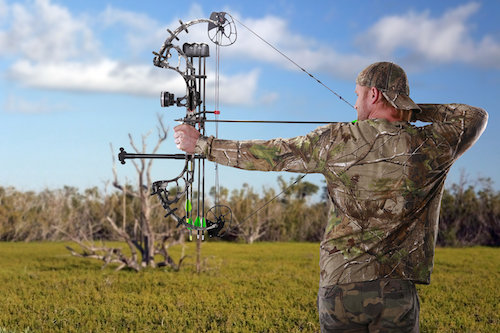
A compound bow is a modern bow made up of cables, pulleys and cams that make it easier to draw and easier to hold the draw for a long period of time due to “let off”.
With some practice, a bowhunter can become very proficient at shooting a compound bow, which, with the proper broadhead, results in quicker, cleaner kills.
Compound bows can be fitted with many accessories such as, quivers, stabilizers, bow sights, limb dampeners and more.
Compound bowhunters can also take longer shots than traditional archers.
These bows are usually shot with a bow release, which is a device with a trigger that is used to draw and release the bowstring.
For best results with a hunting bow, we prefer a drop away arrow rest. This type of arrow rest falls away upon release, so there is very little friction or influence on the arrow, resulting in a faster, more accurate shot.
Click here for a guide to the best hunting arrows.
They also use a bow sight that makes finding and hitting your target much easier.
Compound bows are much easier and much more accurate than a traditional recurve bow.
Click here for a list of the best compound bows for beginners.
Recurve Bow

There was a time when a recurve bow or long bow was the only weapon used for bowhunting deer and there are still many traditionalists that prefer the challenge of hunting with a recurve.
Recurve bows are shot using your fingers to draw and release the bowstring, which can be challenging to repeat the release the same each time.
They are also shot instinctively, without the use of a bow sight and without the aid of fancy arrow rests.
Hunting with a recurve bow is not usually for new deer hunters because of the difficulty and the amount of practice and experience that is needed for a successful hunt, but a good beginner recurve bow is a great way to get into trad archery.
Recurve bows require less maintenance than compound bows and crossbows. You should keep the string waxed and once in a while you will have to replace the bow string, but that is about it for maintenance.
Click here for a guide to the best recurve bow.
Crossbow
RELATED: Best Crossbows Rated And Reviewed

There are different types of crossbows and they are all like a combination of a bow and a gun. Shooting a crossbow is simple. It is cocked, or loaded with an arrow, called a crossbow bolt, you aim with a scope and then all that is needed to fire is to pull the trigger.
This changed the game in bowhunting because the most difficult part of bowhunting used to be drawing your bow undetected.
A deer's vision is so much better than a human's and they are incredibly good at picking up movement. Most bowhunters have been caught drawing their bow by deer at least once in their hunting career.
Crossbows have made that a thing of the past.
They are also the most accurate weapon that you can choose for bowhunting and they can even shoot farther than any other bow, although even the fastest crossbows still have limitations on how far you can shoot a deer.
We think that 40 yards is a good maximum on large game animals, but some hunters will stretch that to 50 yards or more.
The farther away the animal is, the more of a chance that it could move, resulting in a poor shot and a wounded animal.
Barnett crossbows make some of the best crossbows for new hunters.
Some of the cons of using a crossbow are that they are much heavier than other bows and you must take the time to uncock a crossbow after every hunt, which can be tricky.
There is also a fair amount of crossbow maintenance that should be performed regularly to insure safe and accurate use of your weapon.
Click here for a guide to the best crossbow broadheads.
Firearms Hunting

Firearms hunting seasons are much shorter than bowhunting seasons, usually lasting a week or two in most states and everyone in the woods or fields should wear blaze orange for their protection..
The problem with this is that it puts all of the firearms hunters in the woods at virtually the same time and has accurately resulted in coining the term “The orange army”, as the woods and fields become overrun with orange clad fellow hunters.
This results in the deer being pushed from everywhere except the thickest most non penetrable habitat available.
More deer on their feet means more deer harvested and most states have a very high whitetail hunting success rate for most hunters during the firearms season.
Let’s take a look at the weapons that are used during the firearms season.
Rifle

A rifle is a long gun that fires a single projectile or bullet from a cartridge that contains gunpowder and a primer.
The name comes from the rifling in the barrel which is used to get the bullet spiralling as it exits the barrel which results in much higher accuracy.
Rifles come in a variety of calibers for hunting deer and other big game. Caliber is the size of the bullet used in the cartridge and a rifle can only fire one size cartridge.
Important Tip For New Deer Hunters - Only use the exact caliber cartridge that a firearm is rated for. Never try to use a different caliber cartridge as it could get lodged in the barrel and cause bodily harm or death.
Some of the most popular calibers for white tailed deer are .243, 270, 280, 7mm, 30-30, .35, 30-06 and 308. Local laws will determine the minimum caliber that you can use.
Rifles have a very long range depending on the caliber used and with a little practice can be used to shoot big game animals hundreds of yards away.
Shotgun

Shotguns are similar to rifles, but are used at shorter ranges and they are capable of shooting multiple projectiles out of a single cartridge.
Shotguns traditionally have had a smooth bore barrel without rifling, which made tham much less accurate than rifles, however specialty rifled barrels are now available and widely used for most shotguns during deer hunting season.
Some states limit the use of firearms to only shotguns for deer season.
Shotguns are available in multiple gauges with 12 gauge and 20 gauge being the most popular for a deer hunt.
Muzzleloader

A muzzleloader, or front loader is the modern equivalent of the musket. It is a firearm that is loaded by adding gunpowder and a ball or bullet to the barrel or muzzle of the gun. The ball is then tamped down onto the gunpowder and a primer is added to the breach.
You then pull back the hammer when you are ready to shoot. When you pull the trigger, the primer is hit by the firing pin, igniting the gunpowder and sending the projectile towards your target.
Muzzleloaders are considered a primitive weapon and have had their own seasons in some states, but innovations in muzzleloading have made these firearms as accurate as rifles.
Rifles, shotguns and muzzleloaders will use either iron sights or a scope for aiming at your target.
3. Learn To Use Your Weapon

This is one of the most important tips for new hunters and it can not be stressed enough.
No matter which weapon you choose to hunt with, make sure that you become proficient with that weapon.
RELATED: What Is MOA? Minute Of Angle Explained
Becoming a good shot with a bow is going to take a lot more time and daily practice then becoming a good shot with a rifle.
You should buy the best archery target that you can afford and try to shoot everyday, even if it is only a few shots. The key to consistency is to establish a habit of working on your form a little every single day.
Make sure that you put in the time and practice necessary to improve your shooting skills and your ability to make a quick, clean kill when the deer presents you with a shot.
Deer Hunting Safety Tips
Safety needs to be your number one consideration regardless of the weapon that you choose.
Most states offer hunter safety courses and will require that you take one before issuing a hunting license. The hunter safety course will give you a good understanding of your state's hunting regulations as well as teaching safety.
Here are some safety tips that you should pay attention to:
- Treat every weapon as if it is loaded.
- Do not load your weapon until you are actively hunting.
- Never point a weapon at anything that you do not intend to shoot.
- Always keep the safety on until you are ready to shoot.
- Be 100% sure of your target.
- Know what lies beyond your target.
- Do not use a scope to scan your hunting area, that is what binoculars are for.
RELATED: Hunting Accident Statistics: Injuries, Fatalities And Causes
4. Where Will You Hunt?

The next step is finding a place to hunt. You basically have two options, hunting on public land or hunting on private land.
Let’s take a look at those two options.